Infrared Sauna vs. Traditional Sauna: What's Actually Different
If you've used a traditional sauna at a gym or hotel, you already have a reference point for "sauna." But infrared saunas work differently — and the difference matters more than the marketing usually explains.
How traditional saunas heat you
Traditional saunas heat the air. Wood, electric, or gas heaters bring the room to anywhere from 175°F to 220°F, sometimes higher. The hot air warms your skin first, then your skin warms your body inward. Most people last 10 to 15 minutes before the air temperature gets uncomfortable.
The benefit comes from the cardiovascular response — your heart rate rises, you sweat heavily, and the body works to cool itself. It's an effective practice with a long history. It's also a sensory commitment: the air is genuinely hot, the breathing feels heavy, and "easing into it" isn't really an option.
How infrared saunas heat you
Infrared saunas operate at lower air temperatures — typically 120°F to 150°F — but heat the body through infrared wavelengths instead of hot air. Those wavelengths pass through the air and are absorbed by your tissue directly. The result: deeper heating at lower ambient temperatures.
That tradeoff is what makes infrared saunas a different experience. The air is breathable. You can stay longer — 30, 40, sometimes 45 minutes — without the same heat fatigue. Sweating is heavy, but it builds gradually rather than hitting all at once.
What red light therapy adds
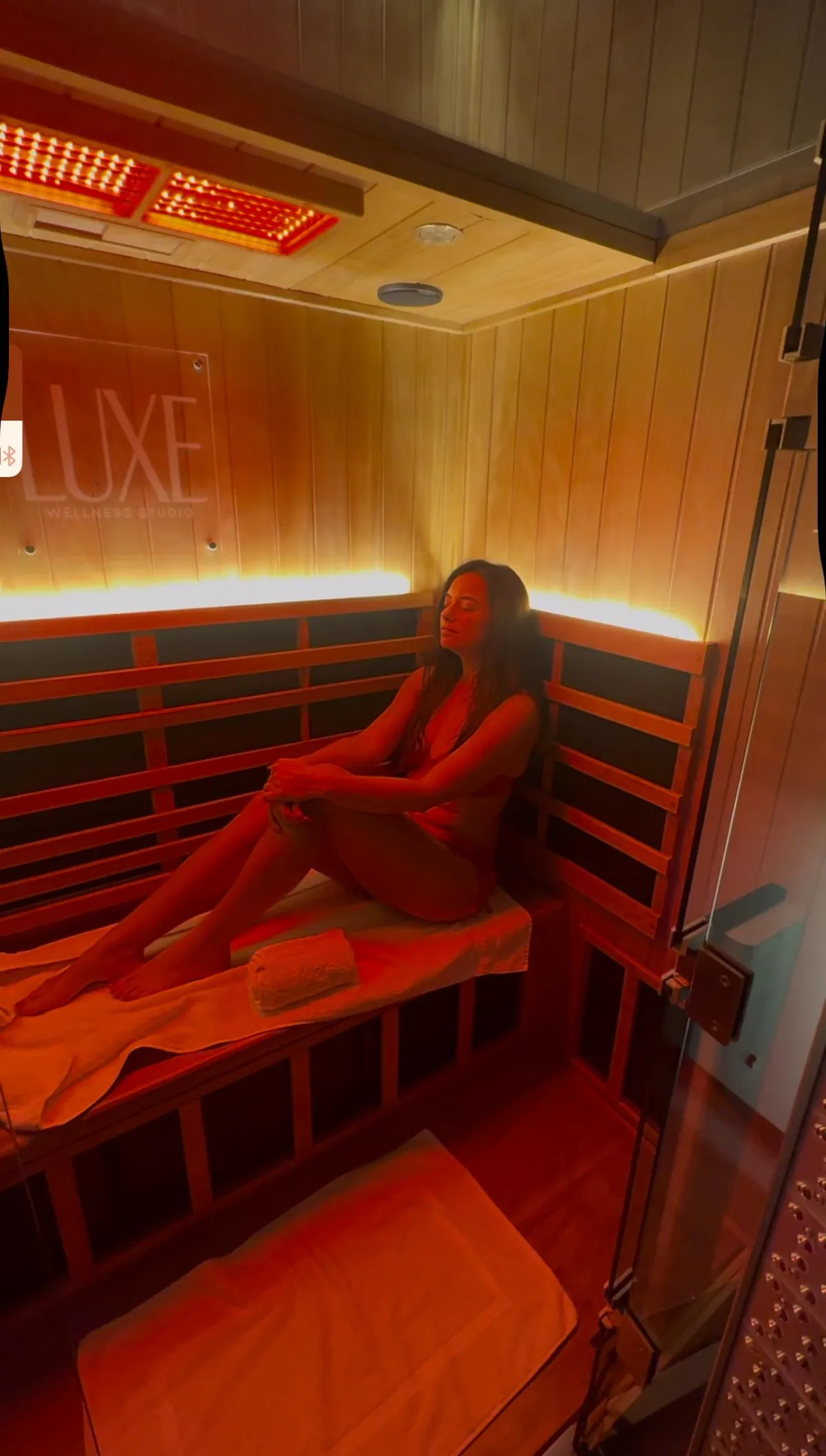
The Clearlight infrared saunas at Luxe include built-in red light therapy panels that run at the same time as the sauna. This is where the real differentiator shows up.
Red light at 650nm and near-infrared light at 850nm are absorbed by mitochondria, supporting cellular energy production. The most-cited benefits in clinical research:
Improved skin texture and collagen production
Reduced fine lines and wrinkles
Reduced inflammation and muscle soreness
Faster wound and tissue healing
Mood and sleep support
The point isn't that red light therapy is magic. It's that you're getting a second well-studied modality during the same 30 to 40 minutes you're already in the sauna. Two practices, one session.
Why we chose Clearlight
Not all infrared saunas are equal. We chose Clearlight Sanctuary saunas for the Luxe suites for a few specific reasons:
Low-EMF design
Clearlight publishes third-party EMF readings, and theirs are among the lowest in the industry. If you're going to spend 40 minutes in a sauna multiple times a week, the low-EMF construction matters more than it might for an occasional user.
Full-spectrum heating
The Sanctuary panels deliver near, mid, and far infrared together — different wavelengths reach different depths. That breadth is part of what makes the heating feel even and complete instead of surface-only.
Built-in red light + chromotherapy
The red light panels are integrated, not add-on. So is the chromotherapy color light system. You don't have to choose what you're getting — it's all running at once.
Infrared isn't a "better" sauna. It's a different one — designed to be used longer, more often, and with light therapy built in.
Which one is right for you
If you love the intensity and tradition of a traditional sauna, that's a real practice. We're not arguing against it. But for the kind of routine most Luxe members are building — frequent, sustainable, layered with recovery work — infrared is the better fit.
Lower air temperature means longer sessions. Built-in red light means more benefit per minute. And our suites let you pair the infrared sauna with cold plunge for the full contrast therapy practice.
Try a Luxe infrared sauna session at luxewellness.studio.
